

After-hours patient messages, late room preparation and quarterly bonuses can change what employees are owed. Medical practice payroll needs a way to capture these exceptions, even when scheduled hours and base wages look correct.
For practice owners and office managers, payroll compliance for healthcare teams starts with three questions: Which employees qualify for overtime, which time counts as work, and which payments belong in the overtime calculation? This guide explains the federal baseline for covered, nonexempt employees. State and local requirements, employment agreements, and the facts of each arrangement may require additional review.
Establish overtime eligibility before reviewing hours
A clinical title or a salary does not automatically make an employee exempt from overtime. Classification depends on the applicable exemption’s requirements and the employee’s actual duties and pay arrangement. Keep a documented classification decision for each role, including administrative staff, clinical support employees, and supervisors whose responsibilities may change as the practice grows.
Registered nurses paid hourly generally should receive overtime. Some registered nurses paid on a qualifying salary basis may meet the learned professional exemption, while licensed practical nurses generally do not qualify for that exemption. An office manager’s title alone also proves little. Review the relevant duties and pay tests rather than extending a physician’s exemption to everyone working nearby.
Under the usual federal rule, covered, nonexempt employees earn at least 1.5 times their regular rate for hours worked beyond 40 in a fixed, recurring seven-day workweek. Paying every two weeks does not permit averaging a busy week against a quieter one. Build these healthcare overtime rules into payroll settings. Combine hours worked for the same employer across its locations; transferring between offices does not restart the weekly count.
As the U.S. Department of Labor explains in Fact Sheet #54, the special federal “8 and 80” arrangement applies only to qualifying hospitals and residential care establishments with a prior agreement or understanding before the work is performed. It requires overtime for hours beyond eight in a day or 80 in a fixed 14-day period. An ordinary outpatient practice should not assume it qualifies simply because it provides medical care. Confirm eligibility before configuring this alternative, and separately check applicable state requirements.
Capture work outside the appointment schedule
Scheduled clinic hours are an incomplete record of work. Opening tasks, required meetings, room preparation, and messages handled after closing can extend the day. Provide a practical reporting method and make clear that all work must be recorded, even when it was not approved beforehand.
Record after-hours and unapproved work
Consider a hypothetical medical assistant who clocks out, then spends another 20 minutes preparing supplies at a supervisor’s request. That time belongs in the work record. A rule requiring advance approval can guide scheduling and discipline, but it cannot erase compensable work the employer knows or has reason to know occurred. Managers should address the scheduling problem separately from paying for the work.
Meal deductions deserve the same attention. The Department of Labor’s Fact Sheet #53 addresses interrupted meal periods in healthcare settings. An unpaid meal generally requires the employee to be completely relieved of duties. If a receptionist must answer calls while eating, the practice should review whether the period qualifies as unpaid rather than accepting an automatic deduction. Provide a way to flag interruptions and correct recorded time.

Separate standby availability from actual work
The Department of Labor’s Fact Sheet #22 makes clear that on-call pay rules depend on actual restrictions, not simply whether a phone was issued. Federal guidance generally treats waiting on the employer’s premises, or restrictions that prevent effective personal use of the time, as working time. Availability at home may be different when the employee can use the time freely, but added constraints can change the analysis.
Log active responses separately from standby time
Distinguish standby availability from time spent responding. A nonexempt nurse who reviews a message, speaks with a patient, documents the exchange, and consults a clinician is performing work during those tasks. Capture the actual time through a practical log or reporting tool. A flat availability payment does not replace recording and paying for compensable work.
Consider two hypothetical nurses. One carries a phone, can travel freely and answers an occasional call; the other must remain close to the clinic and receives frequent interruptions. Their standby time may be treated differently, even though both are called “on-call.” Document response expectations, location limits and call frequency so a qualified reviewer can assess on-call pay rules. Retain the decision and its basis. Review standby stipends separately for regular-rate treatment; payment labels do not establish an exclusion. Revisit the arrangement when restrictions or response frequency change.
Review bonuses before calculating the regular rate
The regular rate used for overtime can exceed the employee’s stated hourly wage. Shift differentials and nondiscretionary bonuses generally belong in that calculation unless a statutory exclusion applies. Identify what each earning code represents before using it. Sending a bonus through a separate payroll run does not by itself remove its overtime implications.
Distinguish promised incentives from discretionary awards
The Department of Labor’s Fact Sheet #56C explains why a promised attendance award or an announced productivity incentive will generally be nondiscretionary. Calling the payment “discretionary” does not settle its treatment. For the federal discretionary bonus exclusion, the employer generally must retain discretion over both whether to pay and the amount until at or near the end of the period, without an earlier promise creating an expectation of payment.
When an includable bonus covers several workweeks, allocate it to the weeks in which it was earned and determine whether additional overtime is due. The U.S. Department of Labor’s health care overtime guidance describes adjustments for bonuses earned over multiple weeks. Keep the underlying hours and earnings for review. Paying the entire bonus in the current week does not replace reviewing earlier overtime. Assign responsibility for providing the earning period, documenting the allocation and approving any supplemental payment.
A weekly calculation with a promised bonus
For a hypothetical hourly employee, assume 45 hours worked at $24 per hour and a $90 nondiscretionary bonus earned entirely that week, with no other compensation. Straight-time earnings are $1,080; adding the bonus produces $1,170. Dividing by 45 gives a $26 regular rate. The additional overtime premium is half of $26 multiplied by five overtime hours, or $65, making total gross pay $1,235.
This method assumes straight-time has already been paid for all 45 hours, so only the additional half-time premium remains. Using the base wage alone would understate the premium by $5. The example illustrates federal healthcare overtime rules for this specific arrangement; different earning types or applicable state requirements may change the calculation. Have the payroll reviewer verify the assumptions before using it as a template.
Assign the decisions behind each payroll entry
Payroll compliance for healthcare teams needs clear ownership. The office manager verifies time and exceptions, the processor applies agreed earning codes and calculations, and a qualified adviser reviews uncertain legal classifications.
J Solutions provides payroll administration services, including calculations, deductions, processing and reporting. Confirm responsibility for earning codes, regular-rate reviews and earlier bonus adjustments. Define the scope in writing; support does not guarantee compliance.
For medical practices and healthcare organizations, J Solutions can help manage agreed payroll and HR administration. Share employee roles, locations, schedules, standby arrangements and incentive terms through a secure, agreed channel.
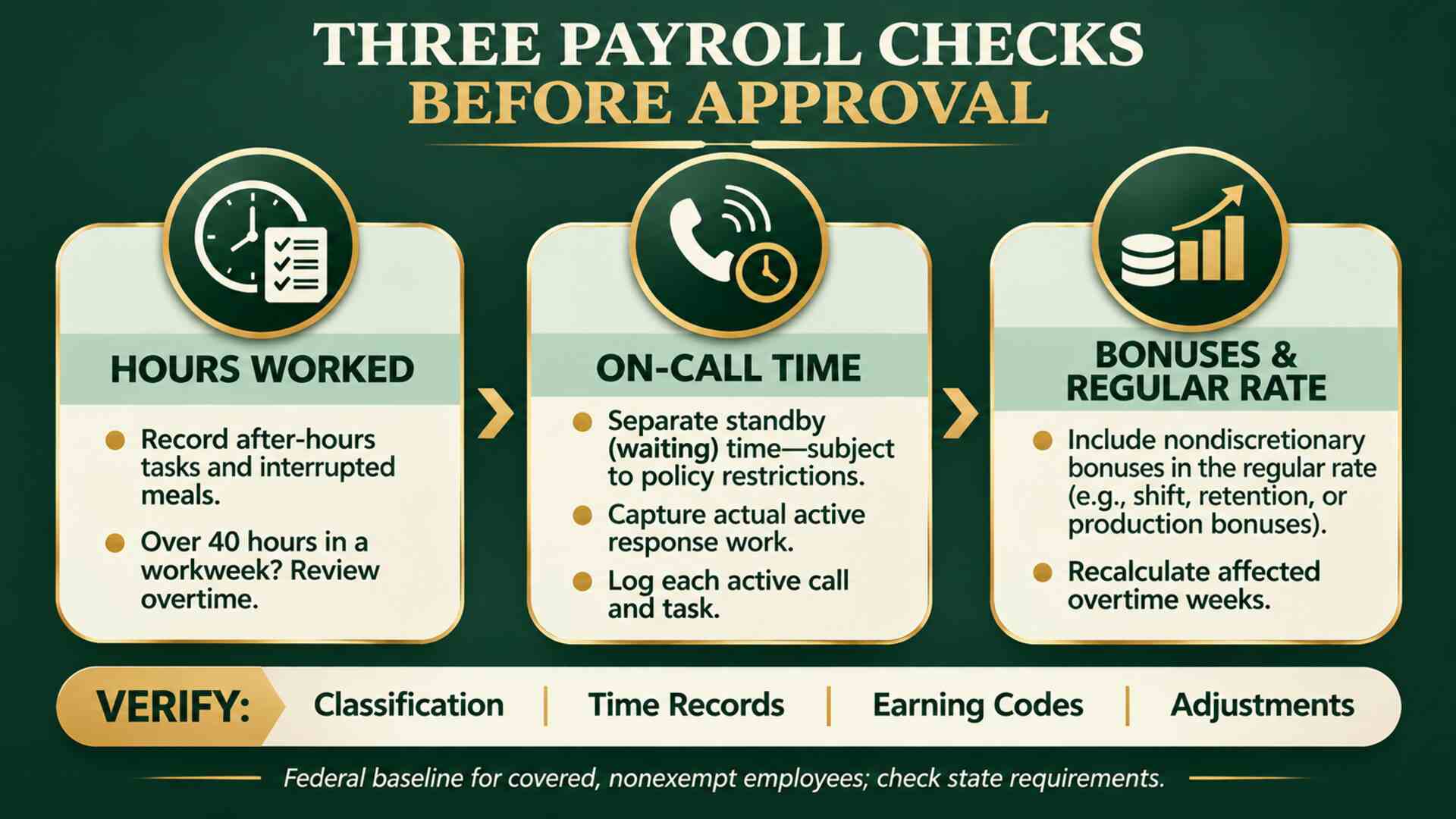
Build an exception review before payroll approval
Before approving payroll, have one reviewer reconcile exceptions against work records and written pay terms. Keep unresolved issues visible with a named owner and follow-up date. Escalate disputed classifications or restrictions for qualified review without postponing legally due wages. Use these three checks:
- Hours: Compare time records with schedule changes, after-hours messages and interrupted meals; correct missing work time.
- On-call arrangements: Match response logs to standby restrictions and flag material changes for qualified review.
- Bonuses: Confirm earning periods, included payments and any supplemental overtime owed for affected workweeks.
J Solutions’ HR compliance support addresses policies and documentation, with responsibilities defined by the service agreement. Use that discussion to identify where qualified legal review is needed, especially for disputed classifications or restrictive standby arrangements. Recheck on-call pay rules when operating conditions change, and review healthcare overtime rules for each jurisdiction where employees perform work.
Make the Next Payroll Review Count
For your next medical practice payroll review, trace one employee’s after-hours work or variable pay through the calculation. Resolve unclear responsibilities before the next run.
Medical Practice Payroll FAQ
Are salaried clinic employees automatically exempt from overtime?
No. Exemption depends on duties, compensation and legal tests, not titles alone.
Does answering patient messages after hours count as work?
For nonexempt employees, handling messages and documenting responses generally count as work.
Is all at-home on-call time paid?
Not always. Pay depends on restrictions and freedom to use personal time.
Can productivity bonuses increase overtime pay?
Yes. Nondiscretionary bonuses generally affect the regular rate and may require retroactive adjustments.
What should a practice check before approving payroll?
Review missed hours, interrupted meals, on-call responses, bonuses and classification questions.