

A Professional Employer Organization, or PEO, provides employment administration through a contractual arrangement commonly called coemployment. Your business continues directing its people and operations while the provider takes on specified employer functions.
A new employee starts Monday, payroll closes Tuesday, and your office manager is still sorting out benefits paperwork. You want help, but who will approve pay changes, answer employee questions, and correct a missed deduction? Behind the question “what is a PEO” is a practical concern about who will do the work.
What Is a PEO in Practical Terms
A PEO may combine payroll processing, benefits administration, employee records, HR guidance, and workers’ compensation coordination. The services included depend on the agreement. For a business with limited administrative staff, that arrangement can provide ongoing support across related functions and reduce the number of tasks the owner must personally organize.
Employees also need to know what changes for them. Their daily supervisor may remain the same, while payroll questions or enrollment paperwork go to the provider. Before starting, explain who handles each request and how employees can reach the appropriate person when a problem needs attention.
Coemployment does not transfer ownership of the company. It establishes a relationship in which specified employment responsibilities are allocated between the business and the PEO. That allocation must be considered alongside applicable law: a contract describes the work each party accepts, but cannot simply erase legal duties imposed on either party.
What the Business Continues to Handle
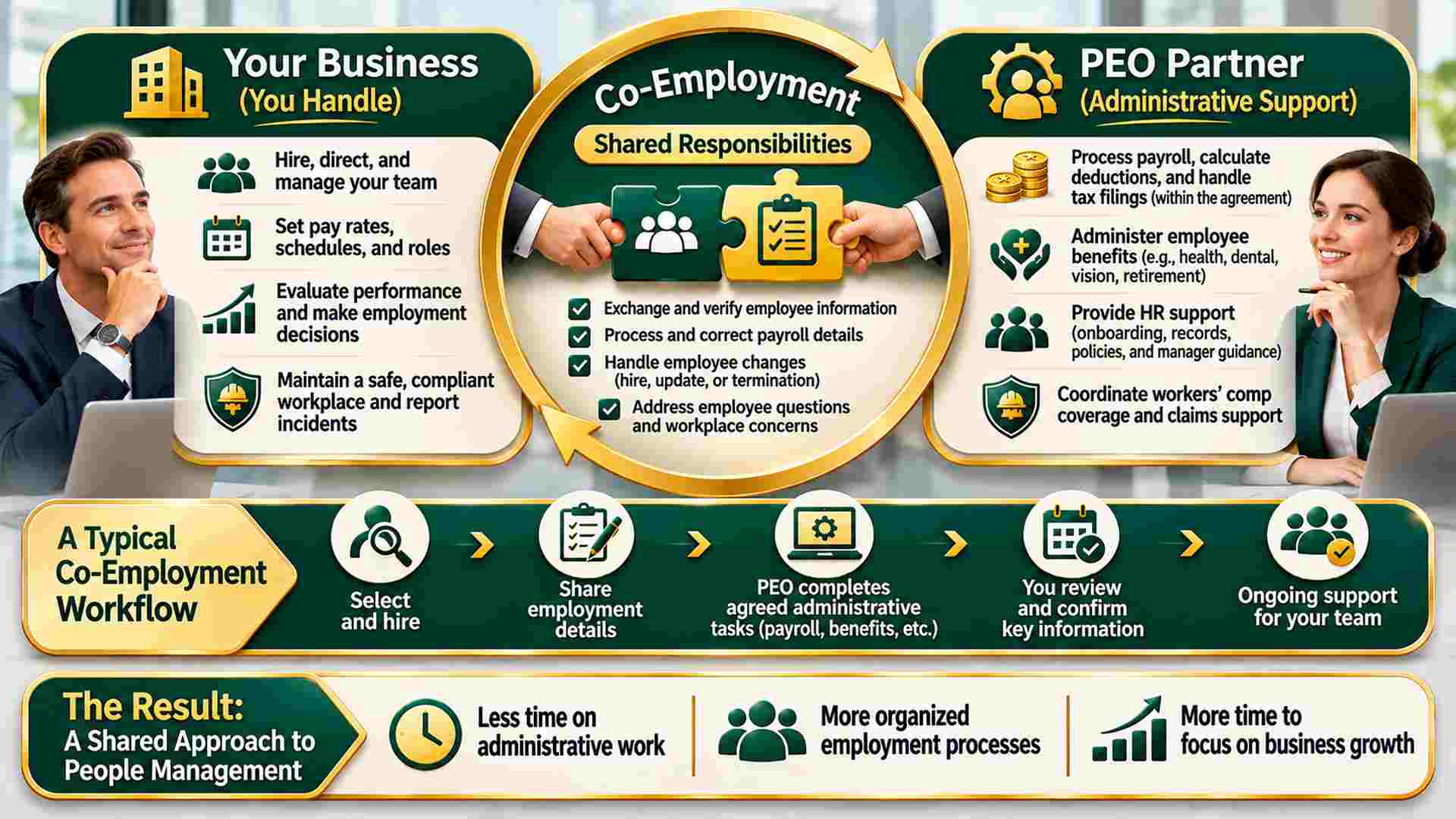
The business generally continues choosing employees, setting compensation, assigning work, establishing schedules, and managing performance. Managers decide what the team needs to accomplish and whether an employee is meeting expectations. A PEO may offer guidance on employment processes, while your supervisors remain responsible for communicating decisions and supplying the facts needed to implement them.
Payroll begins with information your business controls. Supervisors verify working time, communicate approved pay changes, and report employee departures or changes in work location. Designate someone to approve the payroll information before processing. When reviewing PEO employer responsibilities, distinguish the provider’s calculations from the business’s responsibility to submit accurate, complete information.
Workplace concerns also require action within the business. Managers need a clear route for reporting incidents and employee complaints, preserving relevant information, and obtaining HR compliance guidance. For medical practices, clinical supervision and professional oversight require separate attention. Administrative HR support should not be assumed to include medical credentialing or comprehensive healthcare privacy advice.
What Is a PEO Responsible for Administering
Under the agreed scope, the provider may calculate wages and deductions, process payments, maintain payroll records, and prepare designated reports. Your proposal should identify the reporting arrangement, payroll approval deadline, and correction process. Establish who handles an employee’s missing payment and who authorizes any adjustment before the first payroll is processed.
Benefits administration may include enrollment support, processing approved changes, and answering questions about available options. The business still needs to understand eligibility, employer contributions, and communication responsibilities. Plan documents and coverage terms determine benefits; access to a group arrangement alone does not establish a particular premium, coverage level, or savings for your team.
HR support can include onboarding documents, employee handbook assistance, records administration, and guidance for managers. Workers’ compensation services may involve coverage coordination and claims support. Those activities require clear reporting procedures, especially when an incident occurs outside normal office hours. Confirm which services are included and where specialist assistance must be arranged separately.
J Solutions describes PEO and outsourced HR services across payroll, benefits, HR, workers’ compensation, compliance support, and employer risk management. Discuss the particular tasks your team needs help with and the services included in a tailored proposal.
How Shared Responsibilities Work in Practice
Consider a hypothetical medical practice hiring a receptionist. The practice selects the candidate, sets the approved pay rate, and establishes the start date. The PEO helps with agreed onboarding tasks and payroll setup. Before the first payment, the practice verifies the employee’s hours and details, and the provider processes the approved information.
This is how co-employment works during an ordinary administrative task: each side completes work that the other depends on. If the receptionist later receives a raise, the manager authorizes it and submits the effective date. Payroll staff enter the approved change, and the practice checks the resulting report before releasing payroll.
Employee questions need the same coordination. The provider might explain a deduction, while a manager resolves a disputed time entry. When an employee leaves, the business confirms the final working date and approved pay information; the provider completes the agreed payroll and benefits administration. Written PEO employer responsibilities should identify who verifies completion and answers any remaining employee questions.

What a Certified PEO Means for Federal Taxes
A certified PEO (CPEO) has been certified through the IRS’s voluntary program. Certification carries specific federal employment tax consequences. It should not be read as approval of every HR service or a guarantee of service quality. Verify the exact legal entity and its current certification in the IRS public listings, since the name used in marketing may differ from the contracting entity.
IRS guidance for CPEO customers explains that a CPEO generally has sole federal employment tax liability for wages it pays to qualifying work site employees. Both parties may be liable for wages paid to employees outside that category.
Before hiring a CPEO, confirm which workers and payments qualify for the federal tax treatment. A “work site employee” must be covered by a CPEO contract and meet additional rules. One is a work site coverage test: at some point during the calendar quarter, at least 85 percent of individuals performing services for that customer at the site must be covered employees, subject to the rules in Revenue Procedure 2023-18. Have the provider and your tax adviser verify the test.
Form 8973 reports the start or end of a CPEO contract to the IRS. A CPEO contract must identify the exact entity and its employer identification number. The word coemployment alone does not establish federal tax treatment. Review that treatment separately from benefit coverage, workplace operations, and relevant state requirements.
How a PEO Differs From Payroll Processing and Staffing
A payroll processor may handle wage calculations and filings without providing the broader arrangement described here. IRS guidance on third-party payer arrangements explains that outsourcing payroll generally does not remove the employer’s federal employment tax obligations. A non-certified PEO may share those duties without relieving the client of liability; CPEO treatment is a specific exception for qualifying workers and payments.
Staffing services address a different need, typically supplying workers for client assignments. A PEO arrangement generally supports the administration of the client’s existing workforce. If your immediate problem is finding additional staff, clarify whether recruitment is actually included. If your concern is managing employees already on the team, evaluate the administrative functions you need.
Questions to Resolve Before Signing
Compare PEO proposals against the same description of your team. Include employee locations, pay schedules, benefits priorities, and the tasks currently consuming staff time. Separate recurring charges from setup fees, optional services, and costs tied to benefit plans or insurance so proposals can be compared on equivalent terms. Request an itemized example invoice.
Compare the written PEO employer responsibilities with your team’s actual workload. Identify tasks that will move to the provider and those your staff will retain. Before signing, make sure the proposed process answers these practical questions:
- Who approves a payroll correction, processes it, and explains the outcome to the employee?
- Who receives an employee concern or incident report, and how are urgent matters escalated?
- Which records will the business receive at termination, and who coordinates the transition?
Then walk through one complete pay period with the proposed team, including a late change. Resolve gaps before launch and give your staff clear instructions about deadlines, approvals, and where to send questions, so the agreed process can be used consistently.
PEO and Co-Employment FAQ
What is a PEO?
A Professional Employer Organization provides agreed employment administration while your business continues directing employees and daily operations.
Who approves payroll information?
The business verifies hours and approved changes; the provider processes payroll under the service agreement.
Does co-employment remove every employer obligation?
No. Responsibilities depend on applicable law and the agreement.
What does CPEO certification mean?
IRS certification carries specific federal employment tax consequences for qualifying arrangements, employees, and payments.
What should employers review before signing?
Confirm assigned duties, fees, benefits terms, correction procedures, clear employee communication routes, and access to records when the arrangement ends.
Put Your PEO Agreement Into Practice
Turn the answer to “what is a PEO” into a practical check before signing: request a written division of responsibilities and test it against one real situation from your workplace. Use a missed payment, employee departure, or benefits change. Both parties should be able to explain who makes the decision, performs the work, and confirms completion.
Bring that situation and your current HR and payroll process to a discussion with J Solutions. A tailored proposal can help you identify the support your team needs and the work your managers will retain. Resolve any unanswered responsibility questions before launch, then give employees clear instructions about where to direct requests and how unresolved issues will be escalated.