Payroll is ready, but a new employee’s benefits enrollment is unresolved. Your office manager has entered the same information twice and is waiting for help. Another platform might improve data entry without solving the real problem: nobody owns the next step.
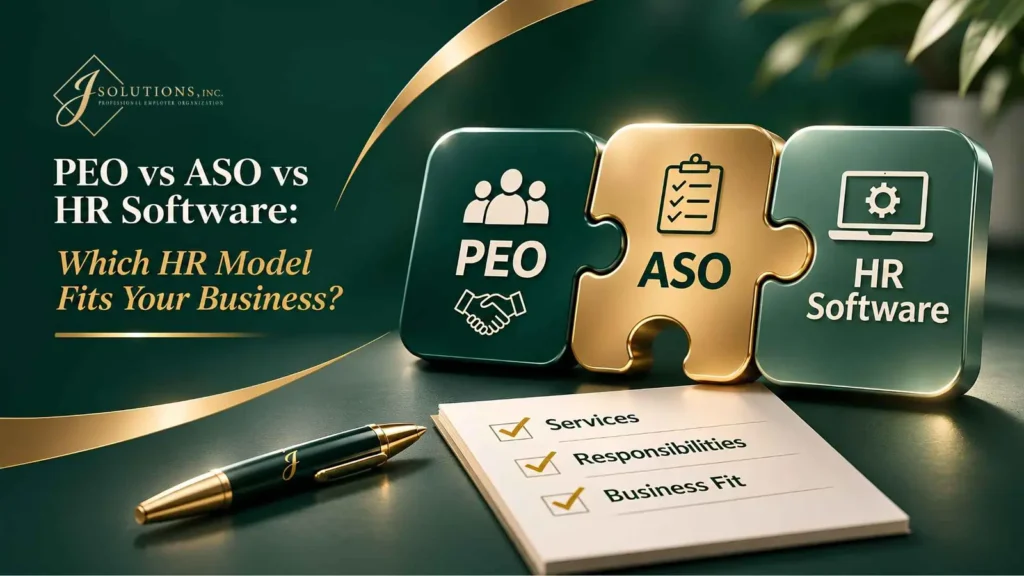
The PEO vs ASO decision starts with that distinction. A Professional Employer Organization shares specified employer responsibilities through co-employment. An Administrative Services Organization performs agreed administrative services without that relationship. Standalone HR software gives your team tools to manage workflows. Base the choice on the work to be completed, the support required and your team’s capacity.
PEO vs ASO vs HR Software at a Glance
| Decision point | PEO | ASO | Standalone HR software |
|---|---|---|---|
| Employment relationship | Co-employment under the agreement | No co-employment | No co-employment from software alone |
| Who completes the work? | Provider and client divide agreed responsibilities | Provider performs selected contracted tasks | Your team operates the tools and resolves exceptions |
| Employee benefits | May offer access to group plans, subject to terms | May administer your existing arrangements | Tracks information; plan access is separate |
| Often fits when | You need coordinated administration and the arrangement fits | You can direct HR internally but need selected work handled | You have capable staff who need better workflows |
| Check before choosing | Retained obligations, benefits and service scope | Exclusions, integrations and escalation ownership | Configuration, integrations and internal capacity |
Start with the work your team cannot finish
Before comparing HR outsourcing models, trace a recent problem. Did payroll stall because managers submitted hours late? Was a benefits change unclear, or did information fail to move between systems? Each calls for a different response.
List unfinished tasks, including payroll approvals, onboarding, employee records and benefits changes. Separate missing information from missing capacity. A provider cannot process unapproved hours, and software cannot resolve an employee dispute. Shortlist options that address the actual gap.
How Each HR Model Works
Compare the employment relationship, services and technology separately. Providers may combine software with hands-on administration, so a familiar label does not establish what a proposal includes.
What a PEO changes
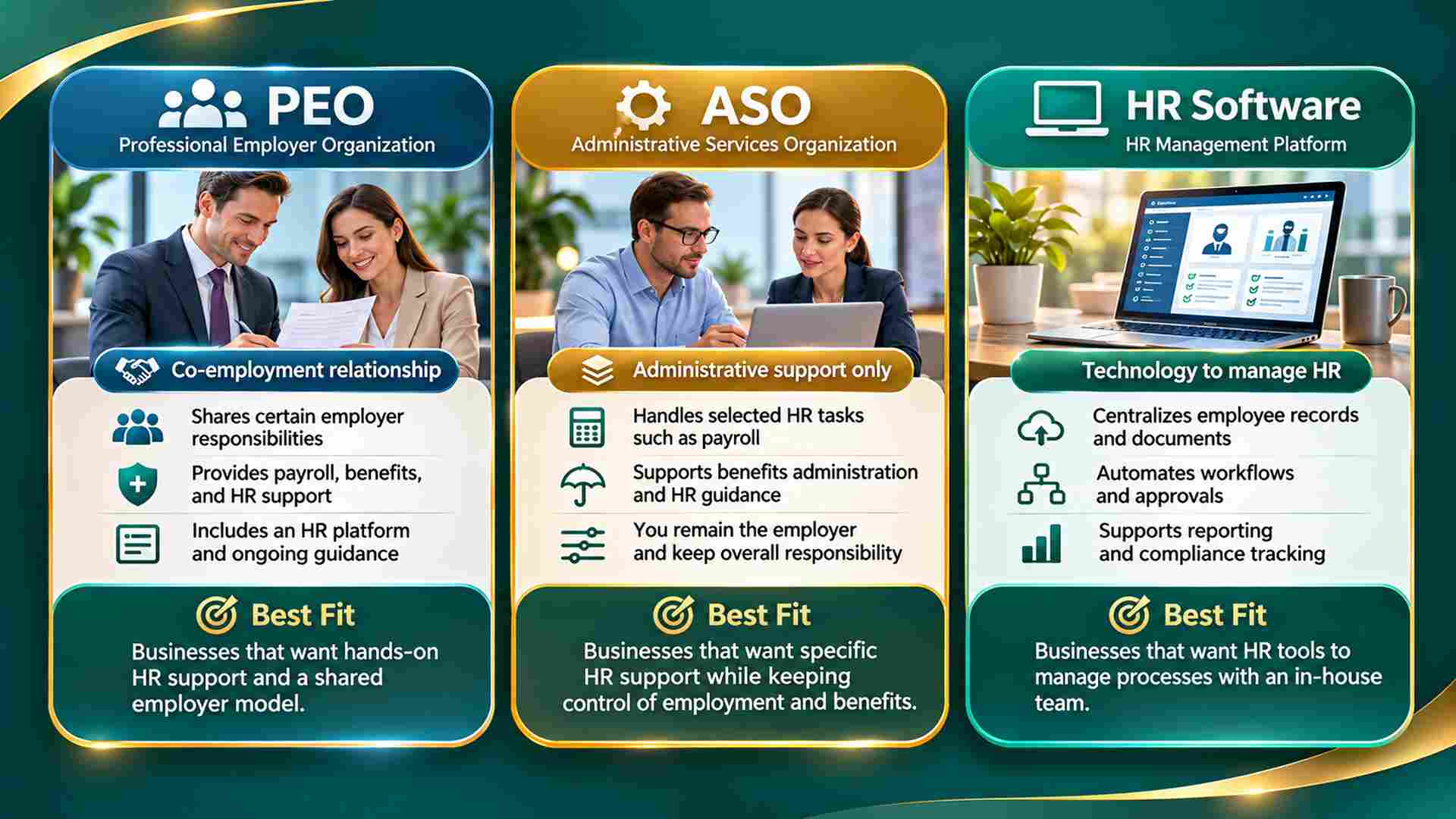
In a PEO arrangement, the client and provider divide specified employer responsibilities through co-employment. The provider may administer payroll, support benefits, and assist with HR processes under the agreement. Your business continues directing daily work, supervising employees, and making operating decisions. The arrangement does not transfer ownership of your company or remove every obligation associated with employing people.
Similar service lists can conceal different benefits arrangements and administrative requirements. Ask what would change for employees and which records and approvals your managers would retain.
J Solutions provides human resources services through a PEO relationship, including documentation, handbooks, onboarding and everyday HR administration. Confirm the services, responsibilities and exclusions for your business in the proposed agreement.
What an ASO changes
An ASO performs selected administrative work without becoming a coemployer. Depending on the agreement, services may include payroll processing, benefits administration, and HR guidance. Your business remains the employer and retains responsibility for coordinating the activities outside that scope.
With an ASO, your business generally coordinates its benefit arrangements and separately purchased services. This can preserve choices you value, but someone internally must connect the pieces. Verify carrier compatibility and who follows up when information fails to reach another provider.
Assess support quality separately from the model. Request service hours and escalation steps. Advice to correct a deduction differs from calculating the adjustment, getting approval and completing the correction. Establish which actions the quoted service includes.
What HR software changes
Standalone HR software can centralize employee records, route approvals, collect documents, and support reporting. Capabilities depend on the product and purchased modules. Your team still needs to configure workflows and handle exceptions. For example, an onboarding system may collect a benefits selection without confirming that the carrier accepted enrollment. Establish which system holds the authoritative record and who reconciles discrepancies.
The PEO vs HR software question is about service as well as technology. Both PEOs and ASOs may include platforms, while some software vendors offer managed services. Compare the purchased scope, then use these starting points:
- Choose software when capable staff need better records, approvals, and reporting.
- Consider an ASO when internal leaders can direct HR but need selected tasks performed externally.
- Evaluate a PEO when coordinated administration through co-employment fits your needs and proposed arrangements.
Compare benefits and payroll responsibilities carefully
Review benefits and payroll separately, then trace how they connect. A proposal should explain which plans employees can join, which records your team maintains and who resolves an incorrect deduction.
Benefits access and administration
Benefits can be decisive because access to plans and administration of existing plans are different services. A PEO arrangement may offer access to group benefits, subject to eligibility and plan terms. ASO support may help administer arrangements your business maintains. Neither description establishes which plans are available, what coverage costs, or whether employees can keep their current providers.
Ask for the actual plan documents and contribution details. J Solutions handles enrollment, plan changes, and related employee benefits administration within an agreed PEO service scope. Use the proposal to establish how eligibility information and payroll deductions will be coordinated.
Payroll processing and tax liability
Payroll also requires a more careful answer than “the provider handles taxes.” The IRS distinguishes several third-party arrangements, with different consequences for federal employment tax liability. Outsourcing processing does not automatically remove an employer’s liability; specific rules apply to qualifying certified PEO arrangements. A contract cannot override applicable tax law. Confirm the arrangement with qualified tax advisers and establish how deposits, filings, notices, and corrections will be monitored.
For any provider or platform, ask who can access employee data, how it is protected, and whether records and attachments can be exported in usable formats when the arrangement ends.
Compare total work and total cost
Comparing HR outsourcing models on price requires proposals covering the same employee population, locations, pay schedule, and services. Separate administration charges, implementation, software modules, payroll processing, benefits costs, and separately billed support. Compare proposed coverage and employer contributions rather than treating unlike plans as interchangeable. Include your team’s time preparing inputs and handling exceptions. A cheaper proposal may simply leave more work with your staff.
Record who supplies information, approves it and completes processing. Include renewal terms, correction fees and termination requirements. For software, account for configuration, training and moving data between systems, even when these costs sit outside the quoted charge.

Test the options against realistic business situations
Consider three hypothetical situations. First, an HR manager faces a seasonal hiring surge. The gap is processing approved employee information, not deciding policy. An ASO may fit if it covers that workload and works with existing benefits. Compare normal staffing needs too, so a short surge does not drive an unsuitable long-term commitment.
Second, an owner and office manager handle payroll, benefits and onboarding without an HR lead. Errors occur between separate providers. A PEO merits evaluation if coordinated administration would address those gaps and its benefits and co-employment terms fit. J Solutions offers PEO support for small and medium businesses; a proposal should identify the handoffs its team manages and the approvals the owner retains.
Third, knowledgeable HR staff spend hours chasing signatures and entering information twice. Better software may help. Ask for a demonstration that follows a new hire through documents, approvals, payroll and benefits. Check for manual transfers and test how an incorrect deduction is corrected.
Plan the transition before ending an arrangement
Before changing arrangements, settle the transition responsibilities. Confirm when payroll processing changes, whether benefits change, and who handles notices relating to earlier periods. For software, confirm which records and attachments can be exported in usable formats. Set dates for testing deductions and reconciling opening balances before the first live payroll. Keep access to necessary historical reports, and assign a backup approver so the transition does not depend on one person’s availability.
Choose a Model With Clear Responsibilities
Base your decision on the work your business cannot reliably complete and the expertise it already has. Ask your team or prospective provider to resolve the opening enrollment example: who verifies coverage, corrects records and updates the employee? If a PEO fits, ask J Solutions for a proposal with clear responsibilities and costs.
PEO, ASO and HR Software FAQ
What distinguishes a PEO from an ASO?
A PEO shares specified employer responsibilities through co-employment. An ASO performs agreed administrative services without that relationship.
Can HR software replace outsourced HR support?
Software organizes workflows, but your team still needs expertise and capacity to complete tasks and resolve exceptions.
Does a PEO remove every employer responsibility?
No. Your business retains daily management and other obligations under applicable law and the agreement.
How should businesses compare these options?
Compare included services, benefits arrangements, total costs, retained tasks, support access, and transition requirements against your actual administrative needs before choosing any service provider.