
Your next payroll date is fixed, but your PEO relationship may no longer fit. Service requests linger, benefits have changed, or invoices are difficult to explain. Knowing how to switch PEO providers starts with protecting accurate pay, confirmed coverage, and access to employee records throughout the move.
A Professional Employer Organization, or PEO, handles agreed employment administration through co-employment while your business directs daily work. Switching requires coordinated handoffs for contracts, payroll, benefits, insurance, and records. Assign an owner to each before choosing the launch date.
Choose the Date Around Your Actual Constraints
January can offer a cleaner calendar boundary, but it is not automatically the best date. Your contract renewal, benefit plan year, payroll schedule, and the incoming provider’s implementation capacity may point elsewhere. Starting at a quarter boundary can simplify reconciliation, although it does not remove reporting obligations or resolve coverage questions.
You may be able to change PEO mid-year if the existing agreement permits the exit and the replacement arrangements are ready. Compare the cost of moving now with the cost of staying until renewal. Include termination charges, setup fees, overlapping administration, benefit changes, and any additional payroll tax cost identified by your tax adviser. A lower administration quote alone does not establish savings.
If you plan to change PEO mid-year, work backward from the first new payday. Identify the funding deadline, data approval date, employee enrollment deadline, and latest valid notice date. Ask both providers to confirm their responsibilities against that calendar. There is no universal implementation period that suits every employer, particularly when multiple states, benefit plans, or unresolved payroll corrections are involved.
For a hypothetical Friday payday, the new provider needs approved hours on Monday and funding on Tuesday. The outgoing provider still owns the preceding pay period. Map those responsibilities separately from the benefits start date, then check for uncovered days. If enrollment remains unresolved at the approval deadline, pause launch and confirm continued coverage and payroll service before selecting another date.
Review the Exit Terms Before Giving Notice
Read the signed agreement and amendments for renewal dates, termination rights, charges, continuing duties, and access to records. Have counsel resolve unclear terms. Before giving notice, obtain the incoming provider’s acceptance and implementation schedule; a pending application is not a replacement arrangement.
Your PEO contract termination notice should follow the agreement’s required recipient, delivery method, and timing. Determine whether the notice period runs from sending or receipt, and whether calendar days or business days apply. Retain the notice and delivery evidence with the transition records. An ordinary email may be insufficient if the agreement requires another method.
Ask the outgoing provider to acknowledge your PEO contract termination notice and confirm final payroll, coverage end dates, outstanding invoices, and record exports. Assign later corrections and tax notices to named teams. Resolve disagreements without assuming an acknowledgment changes the contract.
Resolve Payroll Tax Treatment Before Pricing the Move
An important payroll tax question is whether previously paid wages count toward applicable annual payroll tax wage bases. IRS certification matters here. A Certified Professional Employer Organization, or CPEO, has a specific federal tax status. Verify the exact contracting entity through the IRS public listings rather than assuming that every PEO is certified.
Federal CPEO regulations provide predecessor and successor treatment when qualifying CPEO contracts begin or end for qualifying work site employees. Those rules should not be assumed to cover every employee or every provider arrangement. Before you change PEO mid-year, have your tax adviser and incoming provider document the treatment of prior wages, any wage base restart, and the effect on employer costs. Review state unemployment treatment separately.
Identify which entity will report each portion of wages and who will prepare the applicable tax returns and Forms W-2. Do not assume that importing prior wages makes the incoming provider responsible for earlier filings. J Solutions describes its payroll administration services as including payroll processing and tax administration; the proposed agreement should specify the responsibilities for your transition.
Build a PEO Transition Checklist With Named Owners
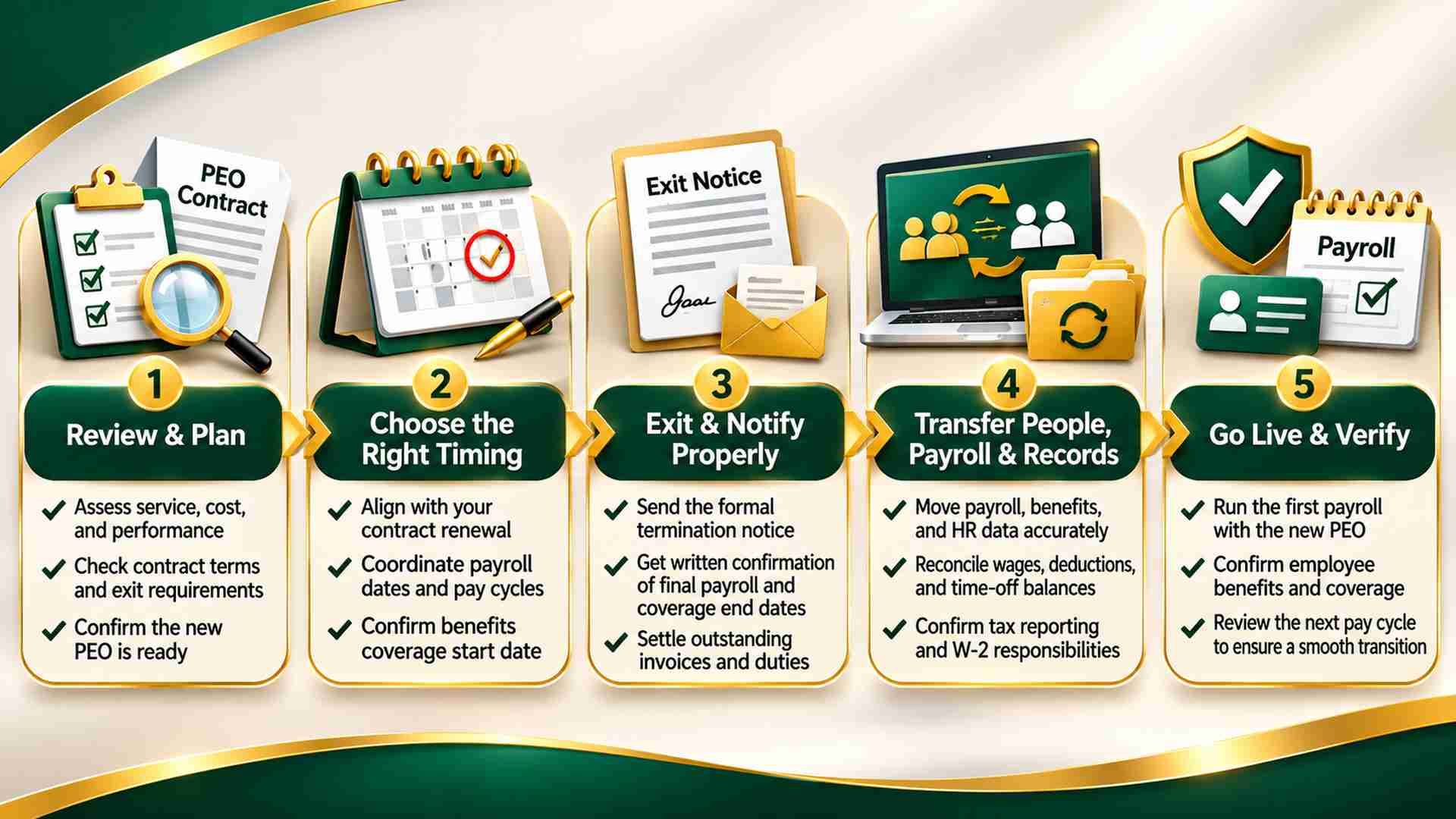
A practical PEO transition checklist assigns owners, deadlines, and completion evidence. Appoint one internal coordinator to track unresolved decisions. An accepted file is not necessarily reconciled, and a submitted enrollment is not confirmed coverage.
- Confirm contract exit terms, the replacement start date, and responsibility for unfinished obligations.
- Reconcile employee records, payroll balances, and coverage dates before approving the transfer.
- Test payroll, confirm funding and enrollment, and name the person authorized to resolve problems.
Record the agreed owner and deadline for each handoff below. Confirm dates with both providers; contract and plan requirements take priority.
| Task | Owner to confirm | Deadline to agree | Evidence of completion |
|---|---|---|---|
| Review the exit terms | Employer and counsel | Before giving notice | Signed agreement, amendments and confirmed exit requirements |
| Agree on the transition calendar | Employer and both PEOs | Before approving the start date | Written payroll, funding and coverage dates |
| Deliver the termination notice | Employer | By the contract-specific notice deadline | Notice copy and delivery or receipt evidence |
| Reconcile and transfer records | Employer and outgoing PEO; incoming PEO validates import | Before payroll setup is approved | Approved roster, year-to-date totals and resolved discrepancies |
| Confirm benefits and insurance | Incoming PEO and relevant plan or insurance administrators | Before outgoing coverage ends | Written coverage dates, enrollment confirmation and assigned open claims |
| Approve the payroll preview and funding | Employer and incoming PEO | Before the agreed funding cutoff | Approved calculations and confirmed funding readiness |
| Verify payments and remaining obligations | Employer and the responsible PEO teams | After the first and following payroll cycles | Payment and deduction confirmations, with correction owners assigned |
Secure the Agreements and Employee Records
Keep the signed replacement agreement, accepted service scope, and evidence of valid notice. Confirm who approves payroll, answers employee questions, and authorizes changes. Export employee details, pay rates, work locations, leave balances, deductions, benefit elections, and relevant personnel documents before access ends. Store them securely with restricted access.
Transfer sensitive information through the providers’ approved secure process. Avoid collecting bank details, Social Security numbers, or medical information through ordinary email. Ask which records can be imported, which require employee action, and which remain in a separate archive. J Solutions offers human resources services involving employee documentation and onboarding; confirm which migration tasks are included in its proposed scope.
Reconcile the Data Behind Each Payment
Match employee counts and identifiers against the outgoing roster. Reconcile wages, withholding, benefit deductions, garnishments, retirement contributions, and leave balances against source reports. Check employees on leave, recent hires, staff receiving payments after termination, and people working across states. A matching company total can conceal an individual error.
Confirm the last pay period handled by the outgoing provider and the first handled by the incoming one. Separate work dates, pay dates, and funding dates so no hours are omitted or paid twice. Document who processes late commissions, bonuses, reimbursements, and corrections. Keep copies of the final approved reports rather than depending on continued access to the old portal.
Confirm Benefits and Insurance Before Announcing Completion
Approve benefits separately from payroll. System readiness does not establish confirmed enrollment or insurance coverage. Review the arrangements before employees choose plans or schedule care.
Check Coverage and Employee Costs
For employees, the practical concern is whether a prescription, appointment, or paycheck will be affected. Obtain written confirmation of the outgoing coverage end date and replacement coverage start date. Compare eligibility, employee contributions, provider networks, and prescription coverage. Ask whether deductible and out of pocket amounts already incurred will receive credit; do not promise that they will transfer.
Review dental, vision, life, disability, and retirement arrangements as applicable. Have the responsible administrators explain outstanding retirement loans, contribution remittances, and any required participant actions. Reconcile cumulative employee deferrals so the new setup accounts for applicable annual limits. J Solutions describes employee benefits administration that includes enrollment and plan changes. Request the actual plan terms and transition responsibilities before communicating specific coverage promises to employees.
Confirm workers’ compensation coverage dates and arrangements for reporting injuries. Assign responsibility for existing claims and incidents reported after the switch. Where applicable, identify who administers continuing health coverage notices and existing participants. The administrative relationship may end while claims, corrections, or participant obligations continue. Keep those responsibilities on the transition calendar rather than treating them as closed at launch.

Test the First Payroll and Explain What Employees Must Do
Request a payroll preview before releasing funds. Compare gross pay, taxes, deductions, employer contributions, and net pay across different employee situations. Investigate discrepancies, allowing for legitimate changes to elections, rates, or plan terms.
Set a Clear Launch Decision
Before launch, confirm enrollment, payroll approval, and funding. Give employees clear instructions for portal activation, forms, enrollment deadlines, the next payday, and questions. Keep managers informed. The move is not complete while employees lack confirmed coverage or payroll access.
After payment, verify deposits and deduction remittances. Reconcile invoices and accounting entries against approved payroll. Keep a correction owner available for missing pay or failed enrollment. Review the following cycle for recurring deductions and adjustments that the first run may not reveal.
Approve the Switch With a Verified Plan
Approve the switch when contract exit, payroll calculations, coverage dates, and record transfers are verified, with an owner for every open obligation. If a critical item remains unresolved, agree on a revised date and confirm continued service and coverage. Bring that plan to your discussion with J Solutions.
Switching PEO Providers FAQ
When should a business switch PEO providers?
Choose a date after checking contract notice requirements, payroll deadlines, and benefits readiness with both providers. January is not automatically best.
Can we change providers during the year?
Possibly. Review exit terms, implementation readiness, and payroll tax treatment before committing.
Will employee benefits transfer automatically?
Do not assume so. Confirm coverage dates, enrollment requirements, and whether deductible credit applies.
What should we check before the first payroll?
Reconcile employee records, preview calculations, confirm funding, and assign correction responsibilities. After launch, verify deposits and deductions, then review the following payroll cycle for recurring errors.